
Insights
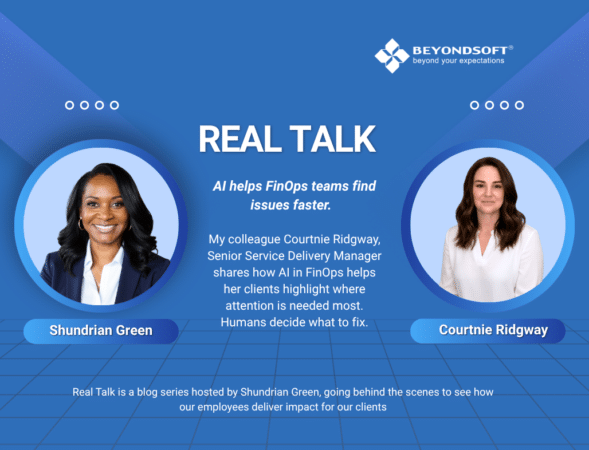
AI Speeds FinOps Analysis. Humans Make Decisions
One of the biggest AI advantages is reducing analysis paralysis. Instead of asking teams to review thousands of data points, AI can quickly highlight where attention is needed most.
Courtnie Ridgway, Senior Service Delivery Manager
Many FinOps tools include capabilities such as forecasting, anomaly detection, and cost optimization recommendations. These capabilities help teams process large volumes of cloud data faster and highlight issues that might otherwise go unnoticed.
But faster analysis doesn’t automatically lead to better decisions. FinOps still depend on business context, governance, and accountability. The question isn’t whether AI can help manage cloud spend. The question is where AI creates value where human judgement still matters.
To explore this balance, I sat down with my colleague, Courtnie Ridgway, Senior Service Delivery Manager, to discuss how cloud financial management is evolving and why the future of FinOps depends on both AI and human expertise.
Shundrian: Before we dive into our topic, tell us a little about your role at Beyondsoft.
Courtnie: I work with clients to improve cloud operations, governance, and financial management. That often means helping teams understand where cloud investments are delivering value, uncover areas where they may be overspending, and what actions they can take to improve.
Work has changed significantly over the last few years. Companies are using more cloud services, more environments, and involving more stakeholders than ever before. As a result, cloud financial management commonly known as FinOps has become much more strategic. It’s no longer just about tracking costs. It’s about helping companies make informed business decisions.
Shundrian: How has the reality of cloud operations changed?
Courtnie: Cloud adoption has matured, and that has created both opportunities and challenges.
Businesses are no longer managing a handful of workloads. They’re managing complex environments that span multiple teams, business units, and priorities. Leadership isn’t just asking what the cloud costs anymore. They’re asking whether those investments are generating value.
That shift has changed the role of FinOps. Teams are expected to provide insights that help leaders balance cost, performance, growth, and operational objectives. FinOps has evolved from a reporting function to helping leaders evaluate tradeoffs across cost, performance, growth, and risk. All these inputs help them to make better decisions for the company.
Shundrian: If companies have more data available than ever before, why are decisions getting harder?
Courtnie: Because more data doesn’t always create more clarity.
Most teams have dashboards, cost reports, monitoring tools, observability platforms, and governance metrics all generating information at the same time. The issue is not access to data. It is knowing which signals matter.
That’s where many companies struggle. They spend considerable time reviewing data without knowing which actions should be prioritized. Cloud environments move quickly. If teams cannot separate noise from meaningful signals, decisions slow down. The real work is turning data into clear options leaders can act on.
Shundrian: Is that where AI creates value?
Courtnie: Yes, especially when there is too much information to review manually.
AI is particularly effective at processing substantial amounts of information and identifying patterns that would be difficult or time-consuming for humans to find manually. It can help detect anomalies, improve forecasting, identify optimization opportunities, and surface trends and emerging cost patterns earlier. Based on my observations, I’ve seen many companies either using AI in FinOps or exploring using AI in FinOps through capabilities like forecasting, anomaly detection, predictive modeling, and recommendation engines. The opportunity isn’t deciding whether to use AI, it’s learning how to use those insights effectively.
One of the biggest AI advantages is reducing analysis paralysis. Instead of asking teams to review thousands of data points, AI can quickly highlight where attention is needed most.
That’s an important distinction. AI isn’t replacing FinOps teams. It’s helping them spend less time gathering and organizing information and more time evaluating options and making decisions.
Shundrian: Can you give us a practical example?
Courtnie: Anomaly detection is a great example.
AI can continuously monitor cloud spend and flag unusual activity much faster than a manual review process. But the alert itself is only the starting point.
Someone still needs to understand the context. Was the spike expected? Did a team launch something new? Was it tied to testing, scaling, or a configuration issue? Should the organization take action, or simply note the change?
That human review matters because not every anomaly is a problem. Some are expected. Some are temporary. Some require action. AI can help identify where to look, but people determine what the signal means.
Forecasting works the same way.
AI can create a baseline forecast quickly. But the most accurate forecasts usually require business input: engineering roadmaps, upcoming launches, expected usage growth, application retirements, and other context the model may not have.
AI is good at identifying what changed. People are still needed to understand why it changed and whether it matters.
Shundrian: If AI can identify opportunities so quickly, why can’t companies simply trust the recommendations and automate the decisions?
Courtnie: Because business decisions are rarely a technical decision.
An AI recommendation might suggest reducing capacity, rightsizing resources, or committing to long-term cloud reservations because the historical data supports that decision. From a purely financial perspective, the recommendation may appear sound.
What AI doesn’t fully understand is organizational context. It doesn’t know about an upcoming product launch, an application retirement, a strategic initiative, a planned acquisition, or a leadership decision to prioritize growth over short-term cost savings.
Every optimization comes with tradeoffs. Someone still has to evaluate the business impact, assess the risks, and determine whether the recommendation aligns with organizational goals. That’s why people continue to own the outcome.
We’ve seen this firsthand with reservation and Savings Plan recommendations. AI identified opportunities to reduce costs through long-term commitments, but discussions with engineering teams revealed upcoming architectural changes and application retirements that the models couldn’t anticipate. By combining AI recommendations with human review, we avoided unnecessary commitments while still validated savings.
Shundrian: What’s the biggest misconception organizations have about AI in FinOps?
Courtnie: Many believe AI reduces the need for expertise.
In reality, we’re seeing the opposite. The companies generating the most value are combining AI-driven insights with experienced practitioners who understand cloud operations, finance, governance, and business strategy. AI accelerates analysis, but expertise remains critical to validation, prioritization, and decision-making.
I often describe AI as a force multiplier for experienced teams rather than a replacement for them.
Shundrian: For companies looking to adopt AI-assisted FinOps, where should they start?
Courtnie: Start with the fundamentals.
Before introducing AI, companies need reliable data, clear ownership, established governance practices, and strong collaboration between finance, engineering, and operations teams. Companies also need clear ownership for validating AI-generated recommendations before taking action. AI can accelerate analysis, but accountability still belongs to people.
If those foundations aren’t in place, AI won’t solve the problem. It will simply process poor data faster and generate recommendations without context needed to act on them confidently.
The companies that are most successful with AI-assisted FinOps already have disciplined FinOps practices. They understand how decisions are made, who owns them, and what business outcomes they are trying to achieve. When those foundations exist, AI becomes a force multiplier.
Shundrian: What’s the one thing you hope leaders take away from this conversation?
Courtnie: The future of FinOps isn’t AI versus humans.
AI can help teams move faster, uncover opportunities sooner, improve visibility, and make sense of increasingly complex cloud environments. It cannot replace judgement. It can surface trends, flag issues, and recommend actions. But business context, governance, and accountability still belong to people.
The companies that will see the greatest success are the ones that learn how to combine the speed of AI with the judgment and experience of their teams.
Closing Thoughts
As our conversation wrapped up, one theme remained consistent throughout: cloud financial management is becoming more complex. AI can help FinOps teams analyze data faster, identify anomalies sooner, and uncover optimization opportunities more efficiently.
But AI alone does not create business value.
It can show teams where to look. People still need to decide what matters, what risks are acceptable, and which actions support the business. The most effective FinOps programs combine AI-driven insights with human judgment, governance, and business context. That’s where we help clients succeed.
We combine cloud expertise, FinOps discipline, operational governance, and AI-enabled insights to help you turn data into actionable decisions while balancing cost, performance, risk, and business priorities with confidence. If you want a partner to build AI FinOps, reach out.
Our success factors
Our proven track record is reflected in the results we deliver for our clients. With our global head office in Singapore and 15 regional offices worldwide, we support teams wherever they operate.

30+ years helping mid-sized and enterprise teams deliver on strategy

30,000+ experts across four continents

Certified capabilities * (ISO, CMMI, Azure Expert MSP), helping you manage risk and compliance

Global delivery model across 15 countries, supporting priority work around the clock

Microsoft Frontier Partner