
Insights
Managing the Shift from Manual Operations to AgentOps
Today, leaders assume AI will be part of their workflows. What they want to know is who owns the risk when something goes wrong.
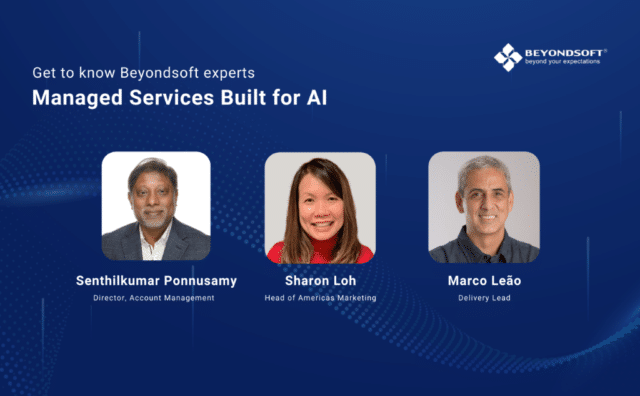
In this video, Senthilkumar Ponnusamy, who leads Client Relationship and Account Management for Life Sciences, Healthcare, and Media customers, and Marco Leão, our go-to-market Delivery Lead, share what’s changing now that AI handles parts of the operation itself.
“Keeping the lights on used to be the hard part,” Marco Leão told me. “Now the challenge is managing the shift from humans running operations to AI and automated agents doing it.”
Senthilkumar put it a different way: “Customers rarely remember the technology itself. They remember whether it helped their business move faster, reduce risk, and create confidence across the organization.”
The Real Problem
Many AI initiatives generate too much noise and not enough clarity. Teams struggle to spot the patterns that matter, catch issues early, or turn any of them into action.
For the past decade, humans made the operational decisions and machines just executed them. Now AI agents make the decisions, and every one of those decisions carries a risk. Someone has to be accountable for that governance decision.
Put those two problems together in Healthcare or Life Sciences, where HIPAA compliance and audit trails aren’t optional, and the bar climbs even higher.
With IT teams already stretched thin, Senthilkumar and Marco Leão walk through practical tips to help their customers prepare for AgentOps.
There is no one-size-fits-all model for this shift. That’s why Managed Services built for AI isn’t a one-off project. It’s a partnership built on trust, accountability, and continuous improvement as more workflow operations shift to AI.
Timestamps
02:51 The AI challenges customers are running into.
05:41 Where we help clients spot connections and fix them.
08:05 AI trends reshaping Managed Services right now.
11:06 Key takeaways for anyone bringing AI into their operations.
How Senthilkumar Ponnusamy and Marco Leão Approach It
Start with visibility: Senthilkumar’s team checks ticket patterns, escalation trends, and SLA performance before touching a new platform. That’s usually where the real gaps show up: visibility, ownership, accountability.
Build reusable blueprints: Marco Leão’s teams standardize infrastructure so operations stay consistent as customers scale, instead of piling up modernization debt from manual, one-off fixes.
Govern AI workloads the same way you govern everything else: Security, identity, and policy controls all sit in one control plane, so no important issue slips through the cracks across five disconnected tools.
Track cost continuously: Teams measure FinOps alongside operational metrics as the work happens, so they catch budget issues early instead of finding them at quarter’s end.
Insights from Senthilkumar Ponnusamy and Marco Leão
“Choose a partner, not a provider. A real partner keeps challenging your assumptions and stays aligned with your business, not just your contract.” — Senthilkumar Ponnusamy
“The direction is clear: less manual intervention, more self-optimizing systems, and teams freed up to focus on what actually moves the business.” — Marco Leão
Let’s connect if you want to talk through what any of this looks like for your environment.
Our success factors
Our proven track record is reflected in the results we deliver for our clients. With our global head office in Singapore and 15 regional offices worldwide, we support teams wherever they operate.

30+ years helping mid-sized and enterprise teams deliver on strategy

30,000+ experts across four continents

Certified capabilities * (ISO, CMMI, Azure Expert MSP), helping you manage risk and compliance

Global delivery model across 15 countries, supporting priority work around the clock
Microsoft Frontier Partner