Insights
Is Your Company Hiring for Today’s Needs, or Tomorrow’s Opportunities?
A big part of my job is helping hiring teams look beyond titles and focus on transferable skills, curiosity, adaptability, and the capabilities that will matter as the role grows.
Katie Ford, Recruiting Manager, Beyondsoft
Behind every successful business is a team of talented people, but building that team is becoming increasingly complex. As companies navigate rapid technological change and growing competition for skilled professionals, recruiting has evolved into much more than a hiring function.
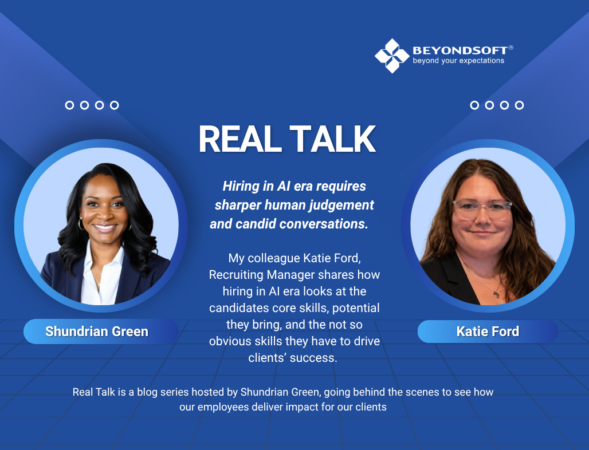
In this edition of Real Talk, I had the opportunity to speak with Katie Ford, our Recruiting Manager at Beyondsoft, about the changing talent landscape, the role recruiting plays in business success, and the trends shaping the future of hiring.
Shundrian: Tell us about your role.
Katie: I’m a Recruiting Manager at Beyondsoft, so a big part of my role is helping our recruiting team connect great people with the right opportunities. I also spend a lot of time helping our teams and clients get clear on what they really need before we start looking for the right person.
To many people, recruiting can look like filling open roles. But there is a lot more happening behind the scenes. We have to understand the business problem behind the role, the skills that matter most, what the market looks like, and how to recognize candidates who may not check every box but still have the foundation to be successful.
That matters even more in fast-changing areas like AI and emerging technologies, where the perfect candidate often does not exist on paper yet. A big part of my job is helping hiring teams look beyond titles and focus on transferable skills, curiosity, adaptability, and the capabilities that will matter as the role grows. I enjoy being able to bridge that gap between what the business teams’ needs and where the right talent can be found.
Shundrian: I’m curious, what made you want to be a recruiter?
Katie: I didn’t grow up thinking, “I want to be a Recruiter when I’m older.” A friend of mine was a Recruiter. He thought I’d be a good fit. I didn’t think much of it at first, but the idea stuck.
I was a Business Management major in college, so the business side came naturally to me. What I didn’t expect was how much I’d care about the people side too. Recruiting turned out to be a place where those two interests came together.
My first job search taught me that fast. I remember how overwhelming that first search felt. I had no idea how to navigate the process, or what employers were looking for. Twelve years later, I’m still in that world, but now I get to help other people navigate it.
I love the business side of recruiting. I enjoy partnering with leaders and helping build teams that can grow and succeed. But I never want to lose sight of the other side of what we do: we help people get jobs. That can sound simple, but it really isn’t. A new job can have a huge impact on someone’s life. When a candidate trusts you with such an important decision, that’s a responsibility I never take lightly.
That’s still what keeps recruiting interesting to me after 12 years. Every candidate has a different story, and every career move is personal. Sometimes we’re helping someone take a big risk they weren’t sure about. Other times, we’re helping someone see an opportunity they hadn’t considered. Being able to build great teams while also helping someone take the next step in their career is what makes recruiting so rewarding to me.
Shundrian: What’s the biggest misconception people have about recruiting?
Katie: I think the biggest misconception is that recruiting is primarily about matching resumes to job descriptions. That’s part of it, great recruiting comes down to understanding people, the business, and identifying potential.
A candidate may not check every box on a job posting, but that doesn’t mean they can’t succeed in the role. Some of the best hires I’ve seen were individuals who brought strong foundational skills, adaptability, and a willingness to learn. Our job is to look beyond what’s on paper and understand what someone can grow into, not just what they’ve already done.
People often forget that our role leads to where our future employees begin. In almost every scenario, a recruiter is the first representative of our company that a candidate interacts with, and that is a responsibility we do not take lightly.
Every interaction matters. The way we communicate, the questions we ask, the candidates we present, and the experience we create all contribute to how candidates perceive Beyondsoft. We’re a trusted partner to the business teams and a strong advocate for the candidate experience.
Ultimately, our job goes beyond finding qualified talent. It’s helping the right people understand why they should want to join Beyondsoft and make sure that the people we bring in are positioned to be successful.
Shundrian: How can recruiting create a competitive advantage when hiring for emerging technologies?
Katie: I think one of the biggest ways recruiting creates a competitive advantage is by helping the business teams see talent differently. If we wait for talent to have the exact experience, we’re already behind.
AI is probably the best example of this. Demand for AI hiring took off fast, and we were tasked with finding production-level AI talent from a pool that didn’t fully exist yet. The power of a good recruiter is that we know the market so well that we can piece together what a strong candidate profile looks like. We deconstruct the role into its core skills and ask: “Who has the strongest foundation to succeed here?”
For AI, we looked at Machine Learning Engineer roles since most of the AI engineering fundamentals were already in place. Generative AI became another model type rather than an entirely new discipline. We looked at Backend Software Engineers who had spent years building scalable, production-grade applications, developing APIs, architecting distributed systems, and deploying software to the cloud. While they may not have had experience with large language models, they already possessed many of the underlying engineering skills required to build AI-powered applications.
That’s where recruiting becomes a strategic advantage. It’s more than matching keywords or job titles. We understand the underlying skills that make someone successful and seeing talent where others don’t.
Shundrian: How do you stay current on topics like AI-powered candidate screening, recruiting scams, and the rapid pace of change in talent acquisition?
Katie: AI is changing every industry, and recruiting is no different. Right now, it feels like a double-edged sword. On one hand, AI can make parts of recruiting easier and faster. AI note-taking tools help us stay more present in conversations instead of trying to capture every detail while someone is talking. Automation can also help with administrative work, reporting, and seeing patterns in the candidate pipeline. When those tools are used well, they give recruiters more time to focus on the people side of the process.
At the same time, AI brings new challenges. Candidates are using AI to optimize resumes, prepare for interviews, and sometimes present their experience in a way that makes it harder to understand what they have done. We are also seeing more recruiting scams and fake candidate profiles than people may realize. So even though technology can help, recruiters have to be more thoughtful, not less.
For me, staying current means paying attention to the tools, the market, and how candidate behavior is changing. It also means staying close to hiring managers and candidates, so we do not lose the context behind the role or the person. AI can help us move faster, but recruiting still takes judgment. We still have to listen carefully, ask good follow-up questions, validate experience, and make sure we are not letting technology replace the human part of the work.
Shundrian: What’s one hiring mistake you see companies make that often goes unnoticed?
Katie: One hiring mistake I see companies make is over-optimizing the candidate pool. I think of it as “The Optimization Trap”, and I think a lot of it comes down to human nature. When we’re making an important decision, we naturally want to reduce risk and make sure we’re looking at the strongest possible options.
Recruiters play an important role in that process because we talk to the largest number of candidates. We do the initial qualification, understand their experience, assess fit, and eliminate a significant share of candidates who don’t meet the requirements. That filtering is an important part of our job, and it allows hiring managers to spend their time with candidates who have already been qualified for the job.
Where I think companies can run into trouble is when that optimization continues at every level of the process. We narrow the pool, then the hiring manager narrows it further, then an executive or client narrows it again. Each person is trying to make the candidate pool better, and individually, those decisions can make perfect sense. But collectively, the pool ends up too thin.
Sometimes the candidate who gets cut early is the person who would have performed exceptionally well in an interview or brought something to the role that wasn’t obvious on paper. We have to remember that a resume and a screening conversation can only tell us so much.
I don’t think the answer is to lower the hiring bar. In fact, I think it’s the opposite. Recruiters should be doing the heavy lifting to make sure the candidates being presented are qualified, but once we’ve established that qualification, decision-makers should have the opportunity to evaluate a thoughtful range of talent.
The goal isn’t to find the one perfect candidate on paper. It’s to create enough opportunity for the right candidate to emerge through the process. That’s where I think we have to be careful that optimization doesn’t become over-optimization.
Closing Thoughts
What I appreciated most from my conversation with Katie is how clearly she showed that recruiting is more than filling an open seat. When it is done well, recruiting helps teams think differently about talent, understand what the business really needs, and make better decisions in a market that keeps changing.
Katie’s perspective is a helpful reminder that great recruiting is not about finding the person who matches every keyword. It is about understanding the work, the need behind the role, and the potential each candidate may bring. In fast-moving areas like AI and emerging technology, that kind of perspective matters even more.
The strongest hiring teams are not just moving candidates through the funnel faster. They are taking the time to recognize the skills that may not be obvious at first glance.
Thank you, Katie, for sharing your perspective and helping us better understand how recruiting is changing. And thank you to our readers for joining us for another edition of Real Talk.
If you’re searching for a new role, please visit our website career page or follow us on LinkedIn.
Our success factors
Our proven track record is reflected in the results we deliver for our clients. With our global head office in Singapore and 15 regional offices worldwide, we support teams wherever they operate.

30+ years helping mid-sized and enterprise teams deliver on strategy

30,000+ experts across four continents

Certified capabilities * (ISO, CMMI, Azure Expert MSP), helping you manage risk and compliance

Global delivery model across 15 countries, supporting priority work around the clock

Microsoft Frontier Partner