How to Scale AI-Native Engineering Productivity
Balancing speed with quality, trust and governance
This article is part of Beyondsoft AI Accelerators blog series on how we help clients operationalize AI in business workflows and evolve their operating models, turning AI investments into business outcomes.
Most engineering teams are shipping faster than ever as AI handles a huge chunk of the code. That part brings relief to most teams. The problem is what happens next.
If you are a technology leader, the real challenge is making sure that raw velocity turns into reliable releases and measurable business value.
GitLab surveyed 1,528 developers and technology buyers in June 2026. 78% reported faster code output, yet 85% agreed AI moved the bottleneck downstream straight into code review and validation.
So the speed gain is real, but relief isn’t.
Let’s walk through what that means in practice. AI cranks out changes faster than any engineering team can review them. Some companies risk trading stability for speed. Under this pressure, meaningful review risks degrading into a rubber stamp. Engineering teams may celebrate faster delivery, while operations absorb costly rework and clients encounter avoidable defects.
That’s the Trap: Output Goes Up, But Business Outcomes Don’t Follow
The fundamentals of sound engineering haven’t changed: clear intent, high quality, robust security, and unambiguous accountability. What must change is the operating model:
- How should people and AI divide the work?
- Who makes and approves high-risk decisions?
- How can verification keep pace with AI-generated changes?
Speed without validation only compounds technical debt.
Real velocity requires continuous proof, not a checkmark. Reliable AI-native delivery needs evidence of what a change was meant to do, how it was tested, what it could affect, and who approved it.
To turn AI output into engineering productivity, teams must measure outcomes, give agents authoritative context, verify changes throughout delivery, and match human review to risk. That is how faster output becomes reliable delivery and measurable business value.
The AI-Native Lifecycle: What to Measure and What to Change
What to measure for better outcomes
The first shift is aligning your leadership and engineering teams on what productivity means.
Start with customer and business outcomes, then measure software delivery performance: how quickly, reliably, and cost-effectively teams deliver them:
- Business and customer outcomes: Agree on a common metric for improved task completion, fewer support requests, revenue gains or lower operating costs.
- Delivery speed: Define lead time to a verified production change.
- Quality and confidence: Document change failure rate and the share of changes with supporting evidence.
- Delivery economics: Agree on cost per accepted production change, including AI usage, review effort and rework.
- Continuous measurement: Track these metrics against a baseline to confirm gains and catch downstream bottlenecks.
What AI-native delivery requires
Putting this operating model into practice requires clear roles, shared context, integrated tools, and enforceable controls. With harness engineering, your team connects those elements with feedback loops that make agent work reliable and reviewable. Engineers still need time to understand system behavior, and challenge assumptions AI may miss. Passing tests should support that judgment, not replace it.
Your teams also need the skills and organizational readiness to scale:
- Define value upfront. Assign an owner to assess demand, business value, feasibility and total cost, including AI usage. Agree on and document acceptance criteria before building.
- Establish authoritative context. Identify approved requirements, architectural decisions, policies and versions, and verify that agents follow them. Traceability supports governance; enforcement and accountability make it tangible.
- Bound autonomy by risk. Limit agent access and actions, with stronger evidence and human approval for high-risk changes.
- Verify continuously and identify dependencies. Combine software and security testing with agent evaluations and independent architecture review. Assign clear QA ownership, trace dependencies, and check for mistakes that generated code and tests may share. Ensure your team knows the dependencies and able to spot check mistakes not flagged by AI.
Production findings should update requirements, tests and controls, with verification and governance throughout the loop:
Business value and intent → Requirements and design → Build and verify → Release → Production feedback → Refine intent, requirements and controls.
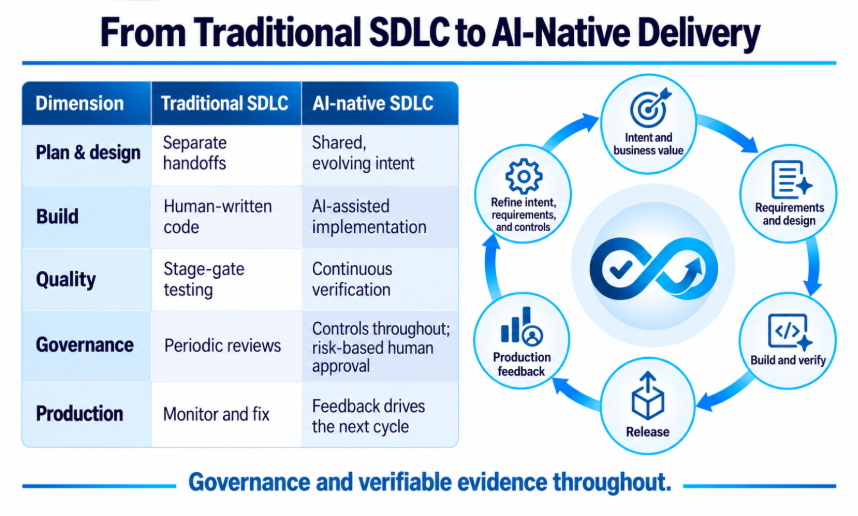
The real productivity gain shows up when teams can trust what they ship, and the people accountable for it don’t have to re-check everything. We can help you get there by improving engineering workflows and automating quality checks
Jack Zhao, Principal Software Development Engineer, Beyondsoft
How We Can Help
We help you advance toward AI-native delivery based on your engineering maturity, priorities, and risk profile. We evolve product and engineering workflows in stages, pairing automation with human judgment to reduce rework, improve delivery confidence, and free teams the decisions that matter most.
We work across five key areas:
- AI-Powered Test and QA Automation: Your teams set the intent and review the results. DES (Digital Employee System), a Beyondsoft AI Accelerator, helps generate, run, and maintain tests through natural conversation, traces them through execution, and supports CI/CD quality gates against agreed release criteria.
- Engineering Performance. We find where delivery is slowing down, whether that is unclear ownership, misaligned tools, or review bottlenecks, and fix the workflow.
- Defect triage, traceability and learning. When something breaks in production, we connect it back to the delivery decision that caused it, route the fix to the right owner, and update the controls so it doesn’t happen again.
- Human oversight by design. We build review checkpoints and controls into your delivery workflows, with human review proportionate to the risk of each change, not on every change equally.
- Forward-deployed engineering. Our forward-deployed engineers (FDEs) work alongside your teams to redesign workflows, integrate AI agents into existing systems, establish the context and governance controls, and stay until outcomes are measurable. We start with a priority workflow, prove it, then scale.
Next Step
AI is moving fast. If your engineering team needs help to turn AI velocity into trusted outcomes, we can help. Book a 30-minute complimentary discussion.